Ultrathin silicon structures can tune mid-IR light in billionths of a second
Light in the mid-infrared (mid-IR) portion of the electromagnetic spectrum plays a key role in modern sensing. Because molecules interact with this kind of light in specific ways, researchers use technologies like mid-IR spectroscopy to identify biological materials, drugs and pollutants. Mid-IR light can also serve as a carrier of information in free-space optical communications, where data...
Injectable nanodevices could provide effective treatment for drug-resistant glioblastoma
Glioblastoma is one of the most aggressive and treatment-resistant brain cancers known to medicine, carrying a median survival of just 12–15 months, even with the best available care.
'White graphene' reshaped at the atomic scale with tailor-made nanopores
A research team at the University of Vienna led by physicist Jani Kotakoski demonstrates how the shape of nanopores in hexagonal boron nitride—the electrically insulating counterpart to graphene, also known as "white graphene"—can be precisely controlled at the atomic level.
Graphene grown on textured copper improves heat spreading for processor cooling
Graphene layers on copper improve lateral heat spreading for processor cooling, while textured surfaces also enhance condensation and wick free vapor chamber performance.
New evidence reveals the Sun's potential for superflares
A reanalysis of the record-breaking 1947 sunspot group provides new evidence that the Sun can generate active regions capable of producing powerful superflares.
Subtle wave plate imperfections enable billion-fold laser suppression
Subtle variations in wave plates can reshape light beams, enabling billion-fold laser suppression and more sensitive optical measurements.
Advanced Nanoscience Facilities at Argonne Unlock Hidden Atomic-Level Properties

Researchers at Argonne are shaping the nanoscience frontier, using atomic-scale control to accelerate advances in electronics, energy storage, catalysis, sensing and medicine.
Twisting 2D Materials Gave Physicists a New Way to Engineer Matter

Placing two lattices - like window screens - on top of each other and twisting one layer compared to the other creates intriguing patterns. In fact, there are toys based on the designs that emerge, called moiré patterns.
Nanoscale HZO-SiO₂ Engineering Stabilizes Resonators Across Wide Temperature Swings

Researchers engineered HZO-SiO2 nanomechanical resonators that use nanoscale oxide layering and phase-dependent elasticity to suppress temperature-driven frequency drift while retaining electrical tunability. The CMOS-compatible platform combined passive thermal compensation with voltage-controlled stiffness tuning, highlighting how ferroelectric oxide nanostructures could support more stable...
Technological roadmap proposed for lifetime brain-wide neural recordings

Understanding the brain requires tools that can follow neural activity across many scales: from millisecond electrical spikes in individual neurons to brain-wide circuit dynamics that change over months, years, and even a lifetime.
Injectable nanodevices could provide effective treatment for drug-resistant glioblastoma

MIT researchers show implanted nanoantennas can be activated wirelessly to kill brain cancer cells without damage to healthy tissue.
Researchers develop biodegradable microneedle particles to enhance drug delivery

Researchers have developed biodegradable particles with microscopic needles that painlessly puncture the skin to help it absorb drugs delivered through patches or creams.
Charge modulation of peptide/nucleic acid complexes: an anionic additive enhances gene silencing and CRISPR/Cas9 editing by promoting intracellular nucleic acid release
IntroductionSmall interfering RNA (siRNA) and Clustered Regularly Interspaced Short Palindromic Repeats (CRISPR)/CRISPR-associated Protein 9 (Cas9) complexes are effective approaches to temporarily downregulate protein expression via post-transcription RNA interference or permanently altering protein expression via editing genomic DNA, respectively. However, the efficient delivery of these...
Scientists observe Einstein’s gravity in the quantum world for the first time
Physicists have directly observed a long-predicted quantum effect of gravity, putting one of Einstein’s foundational ideas to a striking new test. Using ultracold atoms, researchers split an atom’s quantum wave so that one part was held in place while the other fell freely under gravity, then reunited the two to measure the tiny difference that emerged.
AI can now control fusion plasma faster than humans can react
Princeton researchers have tested an AI system that can monitor and control fusion plasma in milliseconds, reacting far faster than a human operator. In one experiment, it predicted a damaging instability about 200 milliseconds before it appeared and adjusted the plasma to stop it from forming.
Dual-drug microneedle patch targets inflammation and fat browning

The worldwide obesity crisis has become a dominant public health crisis across the globe. Over 3 billion people worldwide currently suffer from obesity, and forecasts warn the number will rise above 4 billion by 2035, accounting for more than half the global population.
Fabrication platform could enable flexible, transparent next-generation photonic chips
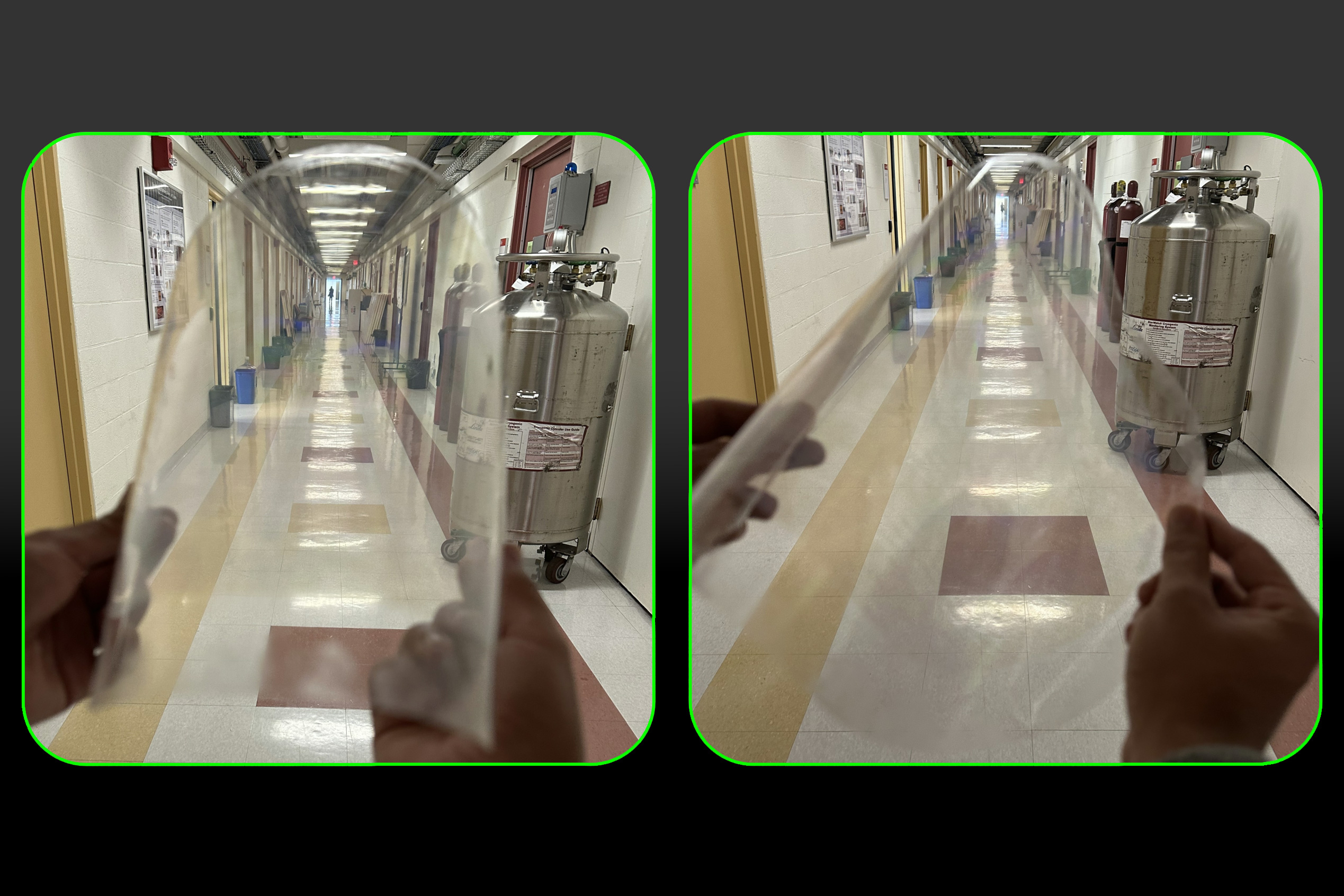
This scalable process produces high-performance chips for applications like discreet wearables or pliable augmented-reality displays.
Scientists just overturned a century-old physics assumption
Scientists at Carnegie Mellon University have discovered an unexpected form of the Hall effect, overturning the long-held assumption that this electrical response only appears when a magnetic field points perpendicular to a material. Beyond expanding a century-old principle of physics, the finding could eventually lead to simpler magnetic sensors for electronics, transportation, and medical...
Surface polarons in Fe-based spin-crossover complexes – a perspective
Fe-based spin crossover (SCO) complexes are a highly versatile family of materials, especially for room-temperature device applications. In addition to their well-documented applications, this class of systems is now theorized to harbor both small and large polarons. Nevertheless, none of their promising applications can be truly realized until a solid understanding of their respective surfaces...
Plant-Growth Synchronized, Acid Phosphatase-Responsive Lignin-Based Controlled Release Phosphorus Nanofertilizers
Developing smarter fertilizer systems that deliver nutrients when and where plants need them could help improve nutrient efficiency while reducing unnecessary losses to the environment. In this article, Alice Boarino, Nicola Carrara, Joaquin Clua, Nick Zahnd, Yves Poirier, and Harm-Anton Klok present a lignin-based nanofertilizer platform designed to respond to a biological signal associated...
Drug that targets an inflammatory enzyme could help prevent lung cancer

A new study by MIT researchers shows that inhibiting caspase-1 can reduce the risk of tumor growth.
Multifunctional Microstructured Surfaces by Microcontact Printing of Reactive Microgels
Engineering surfaces with precisely controlled chemical and structural properties is essential for developing advanced biomaterials, tissue engineering platforms, and biofunctional interfaces. In this article, Inga Litzen, Alexander Töpel, Martin Zenke, Antonio Sechi, and Andrij Pich present a versatile strategy for fabricating multifunctional microstructured surfaces by combining microcontact...
NanoWorld – A New Look for Our Product Labels
Starting August 1, 2026, NanoWorld will begin introducing updated designs for many of our product labels. During the transition period, you may receive products with either the current or the new label design shown below. The label version simply reflects the ongoing implementation of our new labeling system and is not related to the product … Continue reading NanoWorld – A New Look for Our...